
The best blinds for street-facing windows are dual roller blinds and cellular (honeycomb) blinds. Dual rollers combine a light-filtering fabric for daytime privacy with a blockout fabric for night, while cellular blinds add insulation and noise reduction that matters on busy streets.
Street-facing windows present a specific challenge: outdoor light during the day naturally reduces how much passers-by can see inside, but once interior lights are on at night, that effect reverses. The right blind type and fabric resolve this without blocking daylight entirely.
This article covers the most effective blind types for front-facing windows, including how they handle privacy across different light conditions, which fabrics and colours suit wide window spans, and what to expect in terms of fit and longevity.
Ground-floor windows facing a street expose movement and light in ways upper-floor windows rarely do. During daylight hours, the brightness outside naturally reduces the contrast that makes interiors visible. After dark, the dynamic reverses: indoor lighting silhouettes occupants against thin or sheer fabrics.
Solving this requires two things working together: a fabric that restricts daytime visibility without blocking light, and a secondary layer or blockout option that provides complete coverage at night. Dual roller systems address both within a single bracket, making them the most practical solution for front windows that need to work across the full day.
For wide windows in particular, a dual roller system fitted with side channels or a cassette housing keeps the fabric flush and reduces light gaps at the edges, which become more pronounced the wider the span.
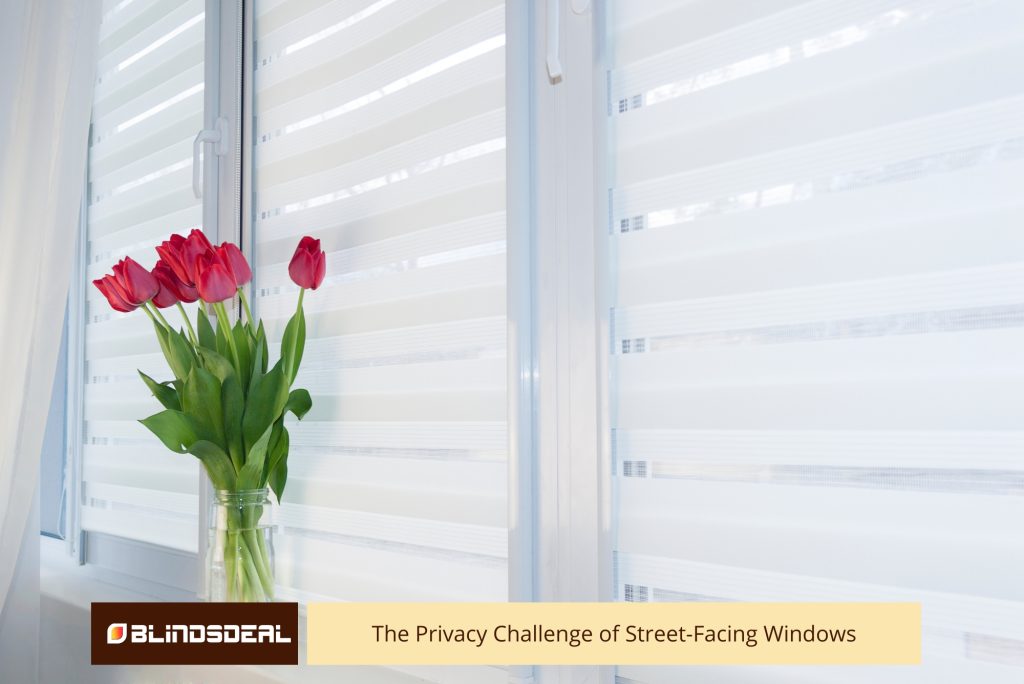
A suitable blind for a street-facing window restricts outside visibility while keeping the interior comfortable. During the day, sunscreen fabrics with an openness factor between 1% and 5% obscure interior detail from the street while still allowing natural light through and preserving outward views.
Fabrics in the 1% to 3% openness range provide stronger daytime privacy; the 3% to 5% range allows slightly more light but reduces privacy in overcast conditions.
Once ambient light levels outside drop below those inside, any fabric thinner than a blockout becomes transparent from the street. To maintain full privacy after dark, a blockout layer drawn separately from the light-filtering blind gives occupants control over both conditions without needing to choose one or the other permanently.
Blockout fabrics also reduce light intrusion from streetlights and vehicle headlights entering the room, which matters for bedrooms and living areas at the front of a home.
Dual roller blinds mount two separate fabric rolls in a single bracket: one sunscreen or light-filtering fabric and one blockout. Each operates independently so occupants can use either layer or both. For street-facing windows, the sunscreen layer stays down during the day, and the blockout is lowered at night. No adjustment to brackets or hardware is needed.
On wide windows, dual rollers are available in wide-width fabric cuts to reduce or eliminate joins. Where a single fabric width is not wide enough, a centre-join or divider bracket maintains the dual-layer system across the full span while minimising visible seams.
Cellular blinds use a fabric structure of adjacent air pockets that trap a layer of air between the window and the room. This construction reduces heat transfer and dampens external noise, both relevant to windows facing active streets.
The insulating benefit is measurable in rooms that previously experienced significant heat gain or heat loss through single-glazed front windows.
Cellular blinds are available in single-cell and double-cell configurations. Double-cell construction provides stronger insulation. They also stack compactly when raised, keeping sightlines clear when privacy is not required.
Cellular blinds do not offer a dual-layer configuration as standard, so for night-time blockout on a street-facing window, they typically work alongside a secondary curtain or sheer rather than as a standalone solution.
Roman blinds fold into horizontal pleats when raised and lie flat when lowered. They suit period homes and classic façades where roller and cellular profiles look too minimal. Light-filtering and blockout fabric options exist, though roman blinds are not available in dual-layer formats.
For wide windows, roman blinds require careful fabric weight selection. Heavier fabrics hold their pleat structure better across wide spans but add weight to the operating mechanism. For spans wider than approximately 2.4 metres, paired roman blinds on a split track are a practical alternative to a single wide blind.
Venetian blinds offer adjustable slat angles that allow fine control over light direction and visibility. Tilting the slats downward directs light toward the ceiling and reduces direct sightlines from street level. Aluminium venetians are suited to modern and industrial façades; timber venetians suit warmer, natural interiors.
For wide windows, venetian blinds can be fabricated in wide widths, though the operating mechanism becomes heavier. At spans above approximately 2.5 metres, two venetian blinds side by side on separate brackets are easier to operate and maintain a consistent appearance.
| Blind Type | Daytime Privacy | Night-Time Privacy | Noise Reduction | Wide Window Suitability |
|---|---|---|---|---|
| Dual Roller | High (sunscreen layer) | High (blockout layer) | Low to moderate | Wide-width fabrics available; centre-join option for extra-wide spans |
| Cellular (Honeycomb) | Moderate to high | Moderate (no standard blockout layer) | Moderate to high | Available in wide widths; pairs well with curtains for night coverage |
| Roman | Moderate to high | High (with blockout fabric) | Low | Suited to spans up to approx. 2.4 m; split track recommended beyond that |
| Venetian | Moderate (slat angle dependent) | Low (gaps between slats) | Low | Two side-by-side units practical for spans above approx. 2.5 m |
Wide windows amplify every fabric characteristic. A slight colour variation between a join seam and the surrounding fabric is more visible on a 3-metre span than on a 900-millimetre window. When specifying fabric for wide blinds, request cut samples from the same fabric roll used for production, and confirm whether the supplier fabricates wide-width blinds from a single fabric width or joins two pieces.
Sunscreen fabrics in the 1% to 3% openness range suit street-facing windows where strong daytime privacy is the priority. For rooms where daylight balance matters more than daytime privacy, a 3% to 5% fabric allows more natural light while still softening interior visibility during bright conditions.
For blockout fabrics on wide windows, a coated fabric with sealed edges reduces light bleed along the sides and bottom of the blind. Cassette housings that enclose the rolled fabric when raised further reduce edge gaps.
Street-facing windows form part of a home’s exterior presentation. Blinds visible through front windows should look uniform in colour, drop height, and style. Inconsistent blind types or mismatched colours across adjacent front windows create visual noise when viewed from the street.
Neutral tones work across most exterior styles: white and off-white suit rendered and painted façades; warm beige and natural tones complement brick and timber cladding; grey and charcoal suit contemporary and dark-palette exteriors.
Roller and venetian blinds suit modern façades; roman blinds read better against traditional and period architecture.
Aligning the drop height of all visible blinds at the same level creates a symmetrical, considered appearance. For wide windows with multiple blinds on a single window opening, confirming that all panels drop to the same height before installation prevents the uneven look that affects curb appeal.
Correct fit directly affects how well a blind performs on a wide, street-facing window. Gaps between the blind edge and window frame allow light to enter and reduce privacy at night even when a blockout fabric is used.
| Fitting Issue | Effect on Wide Windows | Recommended Approach |
|---|---|---|
| Side gaps (outside mount) | Light leaks on both sides, more noticeable on wide spans | Use inside mount with fabric close to reveal, or extend outside mount brackets beyond the frame |
| Centre join visibility | Fabric seam visible from inside and outside | Request same-batch fabric; confirm join placement before fabrication |
| Drop alignment | Uneven drop on multiple panels | Measure each drop independently; confirm at installation |
| Cassette vs open roll | Open roll exposes fabric edge when raised | Cassette housing conceals roll and reduces dust accumulation |
An inside mount (fitted within the window recess) provides a neater appearance from outside and eliminates side gaps where the wall meets the frame. An outside mount extends the blind beyond the frame, which increases coverage and helps reduce light entry for blockout applications but requires precise bracket placement to maintain a level drop.
A suitable blind for a street-facing window manages privacy in both daylight and low-light conditions, fits the full width of the window to avoid edge gaps, and presents a consistent appearance from outside. Fabrics that perform differently at different light levels, such as the sunscreen and blockout layers in a dual roller system, handle the day-to-night shift without requiring the blind to be changed or replaced.
Cellular (honeycomb) blinds reduce sound transmission through the window opening by trapping air in their fabric structure, which absorbs some acoustic energy. The effect is moderate rather than complete sound blocking, and it is more noticeable on windows that previously had no covering at all.
For homes directly facing a busy road, cellular blinds used alongside double glazing or laminated glass provide a more substantial combined reduction.
An inside-mount blind fitted within the window recess eliminates the side gaps that occur when an outside-mount blind does not extend fully past the frame. On wide windows, this matters more because the gap length is longer and more light enters along the edges.
For blockout applications on wide windows, an outside mount with brackets positioned to extend past the frame by at least 50 to 75 millimetres on each side reduces edge light bleed significantly.
Darker fabric colours in sunscreen blinds provide stronger daytime privacy because the denser weave absorbs more light. A charcoal or dark grey sunscreen fabric in a 1% to 3% openness rating restricts interior visibility more effectively than the same openness factor in white or cream.
From outside, lighter colours appear brighter and more reflective, which also reduces visibility into the room during daylight. The choice between dark and light depends on whether reducing interior visibility or matching the home’s exterior appearance takes priority.
Roller blinds with quality fabric and components typically last between seven and ten years under normal residential use, depending on sun exposure, operating frequency, and fabric care. Cellular blinds in similar conditions last a comparable period, though their fabric structure can compress over time if the blind is raised and lowered frequently.
Timber venetian blinds are susceptible to warping in high-humidity rooms such as bathrooms and kitchens and are better suited to drier living and bedroom environments. Regular dusting and avoiding moisture contact extend the lifespan of all blind types.