
Getting the measurement right before you order is the single most important step in the whole process. A blind cut to the wrong size won’t fit properly and can’t be adjusted after manufacture. The good news is that measuring your own windows is straightforward once you know what you’re looking for.
This guide covers everything you need: the right tools, the difference between inside and outside mount, how to measure for each, and the common mistakes that catch people out.
You only need one tool: a metal tape measure. Don’t use a fabric tape or a folding ruler. Metal tapes are rigid enough to give you accurate readings across the full width of a window without sagging in the middle, which matters on wider windows.
Record all measurements in millimetres. Not centimetres, not inches. Blinds are manufactured to millimetre specifications and the order forms use millimetres throughout. Measuring in anything else and converting creates unnecessary opportunities for error.
Have a notepad nearby and write each measurement down immediately. Don’t rely on memory, especially if you’re measuring multiple windows in one go.
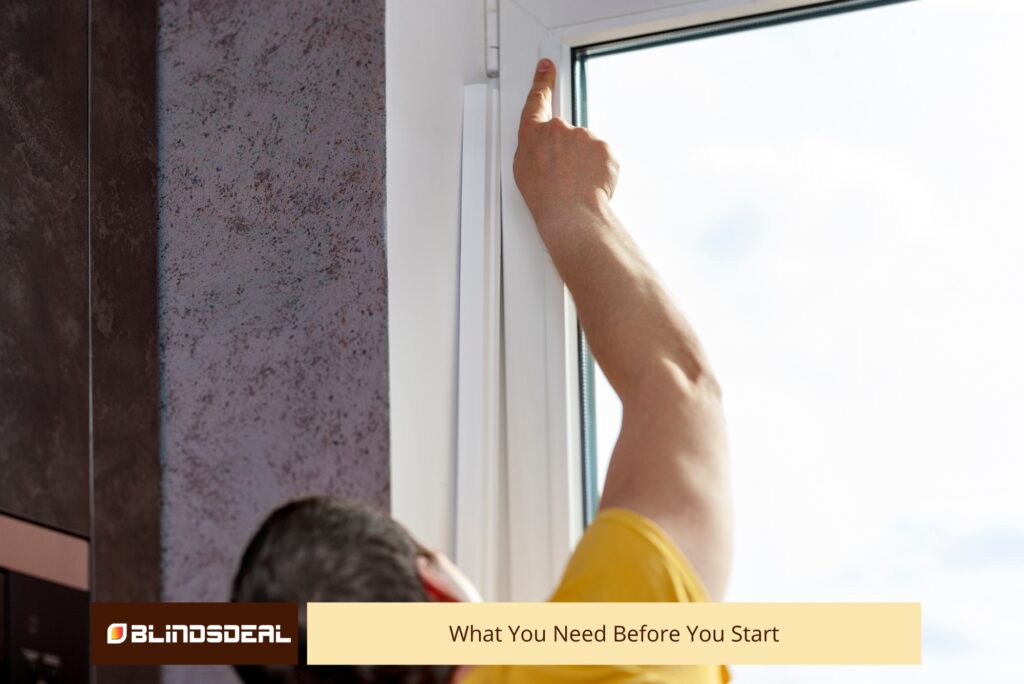
Before you measure anything, you need to decide how the blind will be mounted. This decision affects which dimensions matter and how you record them.
An inside mount blind sits within the window recess, fixed to the inside face of the frame or into the ceiling of the recess. The blind sits flush with or recessed into the wall, which gives a clean, built-in look. It works well in deep window reveals and is the most common choice for modern homes with square, well-proportioned frames.
For an inside mount, you measure the width and height of the recess opening itself, the space the blind needs to fit into. The blind is then made slightly smaller than the dimensions you provide so it clears the brackets and moves freely.
An outside mount blind is fixed to the wall or to the face of the frame, above and outside the window opening. The blind covers the window from the outside rather than sitting within it. This approach works well when the window recess is too shallow for an inside mount, when you want to make a window appear larger, or when you want to block more light by overlapping the frame on each side.
For an outside mount, you measure the area you want the blind to cover, not just the window opening. You choose the width and height based on how much overlap you want, which gives you more flexibility but also more decisions to make.
Measure the width of the window recess at three points: near the top, in the middle, and near the bottom. Window frames are not always perfectly square, particularly in older homes, and the width can vary by several millimetres from top to bottom.
Use the smallest of the three measurements. This is your width figure. Unless you give us specific instructions, we apply a standard 10mm deduction to that figure so the blind fits and operates freely inside the recess.
Measure from the inside face of the frame on one side to the inside face on the other. Don’t measure from wall to wall or from the outer edges of the architrave.
Measure the height of the window recess at three points: the left side, the centre, and the right side. Again, use the smallest measurement as your height figure.
Measure from the top of the recess (where the blind will be fixed) to the window sill. If there is no sill and the blind will hang to the floor, measure to the floor.
For roller blinds specifically, also check the depth of the recess at the top. The bracket and rolled tube need enough depth to sit within the recess without touching the glass. Depth requirements vary with tube size and fabric weight, so send us your recess depth along with your width and drop if you are not sure. If the recess is too shallow, an outside mount is the better option.
Decide how far you want the blind to extend beyond each side of the window opening. We recommend an overlap of 50mm on each side. This covers the frame, reduces light leakage around the edges, and gives the blind a proportional look on the wall.
Measure the width of the window opening, then add your chosen overlap on both sides. So if your window opening is 900mm wide and you add 50mm of overlap on each side, your blind width is 1000mm.
Decide how high above the window opening you want to fix the blind. Mounting 100 to 150mm above the top of the frame makes the window appear taller and allows the blind to clear the frame fully when open. For roller blinds, mounting higher also means the fabric stacks above the glass when raised, rather than sitting in front of it.
Measure from your chosen fixing point down to where you want the blind to finish. This might be the window sill, the bottom of the frame, or the floor, depending on your preference and the room.
For roller blinds on outside mounts, our measuring guide includes diagrams that show exactly where to take each measurement, which is worth checking before you order.
Roller blinds are measured by the width and drop (height) of the fabric panel. The width you provide is the finished fabric width. On an inside mount, this will be slightly narrower than the recess to account for bracket clearance. On an outside mount, it’s the full width you want the blind to cover.
The drop is the length of fabric from the top of the blind to the bottom of the hembar when the blind is fully lowered. If you want the blind to sit at sill height, measure to the sill. If you want it to clear the sill by 20mm, subtract 20mm from your measurement. Roller blinds start from $84 and are available in blockout, sunscreen and light filtering fabrics.
Venetian blinds, both basswood and cedar venetian blinds and PVC, are measured by width and drop in the same way as roller blinds. The width is the finished slat width. The drop is the distance from the headrail to the bottom rail when the blind is fully lowered.
On an inside mount venetian, measure the recess width and height as described above. The blind will be cut to allow clearance within the frame. On an outside mount, measure the area you want covered and add your chosen overlap.
One additional thing to check on venetians is the recess depth. The headrail and tilt mechanism need room to operate, and the slats need clearance to rotate without catching the frame. On a shallow recess an outside mount is more practical.
Vertical blinds are measured by the width of the track and the drop of the slats. The track width determines how much of the opening is covered. The drop is measured from the bottom of the track mounting point to the floor (or wherever you want the slats to finish).
For sliding door applications, which is where vertical blinds are most commonly used, measure the full width of the door opening plus any overlap you want on each side to block light. A 50mm overlap on each side is a reasonable minimum. The drop should let the slats finish just clear of the floor so they don’t drag when the blind is drawn.
The most common mistake is recording measurements in centimetres and then not converting properly. Measure in millimetres from the start and there’s nothing to convert.
Windows are rarely perfectly square. Measuring at only one point and assuming the frame is consistent can lead to a blind that fits at the top but not the bottom, or vice versa. Always measure at three points for both width and height and use the smallest figure for inside mounts.
Width and height get most of the attention, but recess depth matters too, particularly for roller blinds and venetians on inside mounts. A bracket that can’t sit within the recess means the blind ends up on an awkward outside mount by default, or worse, the order has to be remade.
Width is always the horizontal measurement. Drop (or height) is always the vertical measurement. On an order form, entering these the wrong way around will result in a blind made to the wrong orientation. Double-check before submitting.
Check for anything that might interfere with the blind when it’s operating. Handles, locks, window winders, and stay bars all need to be clear of the blind’s path. If a window handle sits within the recess, measure to just above it and use an outside mount instead.
Mounting height matters for another reason too. Under the ACCC’s mandatory standard for corded window coverings, a corded blind has to be installed so a loose cord can’t form a loop 220mm or longer at less than 1,600mm above floor level. If your drop leaves a long chain hanging low, plan where the cleat or cord guide goes at the same time you take your measurements.
It’s worth taking a few extra minutes to remeasure each window before you submit your order. Run through the measurements again from scratch rather than just checking the numbers you already wrote down. If the two readings don’t match, measure a third time to confirm which is correct.
If you’re unsure about any part of the process before ordering, the Blinds Deal team is available to help. You can also work through our full measuring guide, which includes step-by-step diagrams for each blind type and mount method. Getting the measurement right the first time means your blind arrives ready to hang, with no remakes, no delays, and no surprises.