
In a small room, the wrong window covering can make things feel more cramped than they are. Anything that stacks up thickly at the top of a window cuts into natural light. Anything that sits too far from the glass crowds the space. And heavy textures or busy patterns add visual noise that makes a small room feel smaller.
The good news is that several blind styles are genuinely suited to compact rooms. Here is how roller blinds, PVC venetians, vertical blinds, and timber venetians compare, and which works best depending on the room.
The good news is that several blind styles are genuinely suited to compact rooms. Here is how they compare, and why roller blinds tend to come out on top for most small-space applications.
Three things matter most when a room is tight on space.
Stack height is the amount of material that collects at the top of the window when the blind is open. A thick stack blocks light and makes ceilings feel lower. You want something that opens cleanly and stays out of the way.
Projection from the wall is how far the blind sits away from the glass. Even 80mm of projection can feel intrusive in a narrow hallway or small bathroom. The closer to the frame, the better.
Visual weight is how heavy the covering looks on the wall. A plain flat panel reads as quiet and minimal. Deep folds, ruffles, or thick fabric creates visual noise that makes a space feel busier and smaller.
A good way to check a covering before you buy is to consider all three together. A roman blind, for example, folds up at the top when open, which creates significant stack height and blocks the top of the window.
A thick curtain stacks out from the wall on a rod bracket, crowding the room and eating floor space when drawn back.
A roller blind avoids all three problems at once, which is why it tends to be the default recommendation for compact spaces.
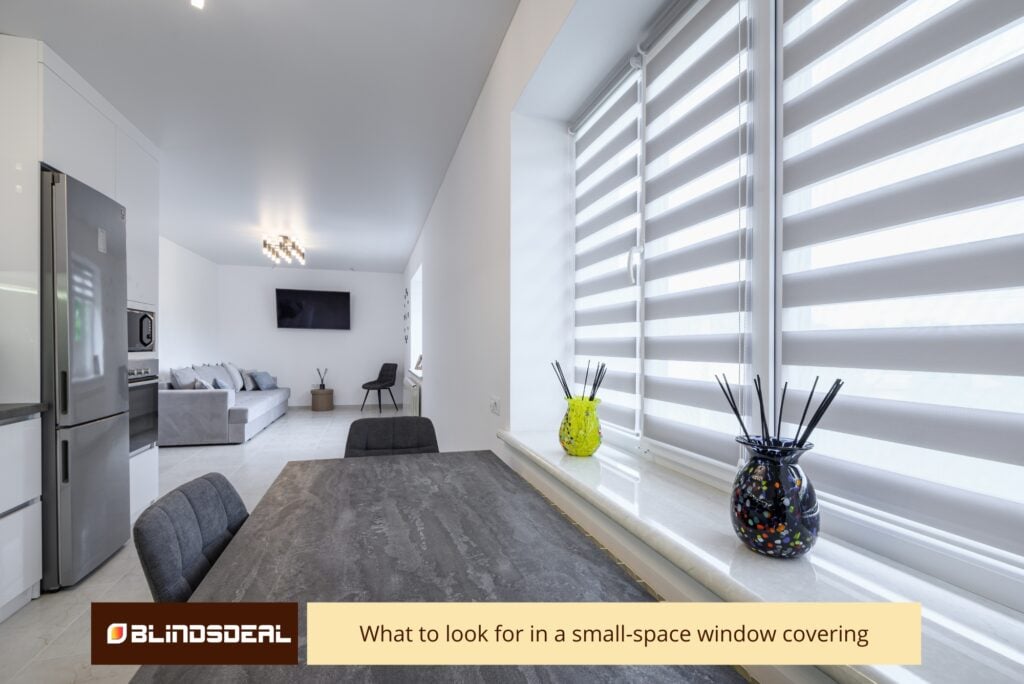
Roller blinds: the best all-round option for small rooms
Roller blinds work well in compact spaces because they tick all three of those boxes.
When open, a roller blind rolls up tightly around a slim aluminium tube. The stack height is minimal, which keeps the top of the window clear and lets in the maximum amount of light. When closed, the fabric lies flat against the glass with almost no projection from the wall, so nothing is crowding the room.
Visually, a single flat panel in a neutral colour disappears into the room. Shades like ice, cloud, mist, and white grey read as quiet and unobtrusive. In a small bedroom or bathroom, that matters. The room feels like a room, not a room with a lot going on around the windows.
Lighter colours also reflect more natural light around the room, which helps a compact space feel more open. In a small bathroom or bedroom with one window, that reflected light makes a measurable difference to how the space feels during the day.
Darker or patterned fabrics absorb light and draw the eye to the window rather than the room, which tends to make compact spaces feel more enclosed.
For bedrooms, blockout fabric (the Vibe Range) is usually the right call. Full darkness improves sleep, and in a small room you want the blind working hard. Available in ice, cloud, mist, and storm.
For bathrooms, kitchens, and compact living areas where you want to keep light coming in, sunscreen fabric (the Duo Range) filters UV and reduces glare without killing natural light. In a small room with limited windows, that can make a meaningful difference to how the space feels during the day. Available in ice white, white, white, grey, and charcoal.
Custom roller blinds at Blinds Deal start from $64, made to your exact measurements. View the roller blinds range and get an instant price.
PVC venetian blinds: good for bathrooms and kitchens
PVC venetians are a solid option for small wet areas. The slats are moisture-resistant and easy to wipe down, which makes them practical for bathrooms and kitchens where condensation is a factor.
The trade-off in a compact room is visual. Individual horizontal slats add more visual texture than a flat roller panel. In a small bathroom that is mostly fine. In a small bedroom or living area, the result can feel busier than you want.
Stack height when fully open is also more than a roller blind, because the slats bunch together rather than rolling up. For a small window that is usually not a problem, but it is worth considering if the window is short to begin with.
Where PVC venetians have an advantage over roller blinds is light control. The slats tilt to angle light up toward the ceiling rather than blocking it outright, which gives you more flexibility through the day. In a small kitchen or bathroom facing a neighbour or a busy street, that adjustability is genuinely useful. You can keep privacy without closing the blind entirely and cutting out natural light.
PVC venetians start from $88 with free shipping Australia-wide.
Vertical blinds: better for large openings than small ones
Vertical blinds are designed for wide windows, sliding doors, and large openings. They stack to one side when open, which means the stack eats into the width of the window rather than the height. In a large sliding door that works well. In a small window it can look and feel awkward.
They are not the first choice for compact rooms. If you have a small study with a sliding door, verticals are still a practical option. But for a small bedroom or bathroom window, a roller blind or PVC venetian will fit the space better.
If your small room has a sliding door or a floor-to-ceiling opening, vertical blinds handle that span better than any other option on this list. A single roller blind wide enough to cover a sliding door becomes heavy and difficult to operate, and two roller blinds side by side leaves a visible gap in the middle.
Vertical blinds avoid both problems. For that specific situation they are the practical choice regardless of room size.
Basswood and cedar venetian blinds look great and add warmth to a room. In a small space, that warmth can work in your favour or against you depending on what else is in the room.
The slats are thicker than PVC, so the stack is deeper when the blind is open. Timber is also not suited to high-humidity rooms like bathrooms. Natural timber absorbs moisture over time, and repeated exposure to steam causes the slats to warp, crack, or discolour.
PVC venetians look similar to timber at a glance but are fully moisture-resistant, which is why they are the practical choice for wet areas. For a small living area or home office where you want something that looks considered rather than functional, timber venetians are worth it. For utility rooms and wet areas, look elsewhere.
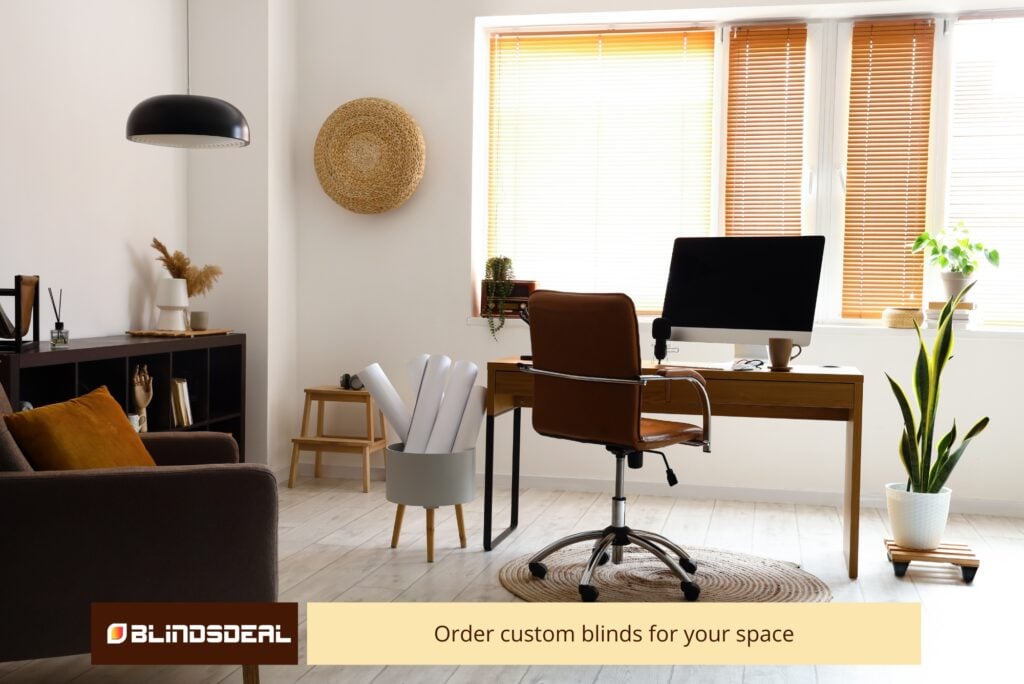
Small windows are less forgiving when measurements are slightly off. With a large window, a few millimetres either way usually does not matter much. With a narrow bathroom window, it can mean a blind that does not sit right in the recess.
Measure in millimetres, use a steel tape, and check the width at three points across the window, using the narrowest. The full measuring guide is here and covers both inside and outside mount.
In a small recess, walls are rarely perfectly square. A difference of 5mm across the width of a large window often does not matter much.
In a narrow bathroom window recess of 400mm, that same 5mm is a meaningful percentage of the total width and can mean a blind that does not sit flush in the recess or leaves a visible gap.
Taking three measurements takes thirty seconds and eliminates the most common fitting problem with small windows.
What are the best blinds for small rooms?
Roller blinds are the best all-round option. They have minimal stack height when open, sit flat against the glass when closed, and a neutral flat panel adds little visual weight. Blockout fabric suits small bedrooms and sunscreen fabric suits kitchens, bathrooms, and living areas.
Are PVC venetian blinds good for small bathrooms?
Yes. PVC venetians are moisture-resistant and easy to wipe down, making them practical for bathrooms and kitchens where condensation is a factor. The trade-off is more visual texture than a flat roller panel, which can feel busier in compact spaces.
Are vertical blinds suitable for small rooms?
Not ideal. Vertical blinds are designed for wide windows and large openings. In small rooms the stack eats into window width rather than height, which can look awkward. For small windows, a roller blind or PVC venetian is a better fit.
How do I measure blinds for a small window?
Measure in millimetres using a steel tape. Check the width at three points and use the narrowest. Small windows are less forgiving than large ones when measurements are slightly off. The full measuring guide covers inside and outside mount.
All blinds at Blinds Deal are made to your exact measurements, cut to fit your specific window rather than trimmed down from a standard size.
That matters in small rooms where a few millimetres either way affects how the blind sits in the recess. Factory direct with free shipping anywhere in Australia.
Browse roller blinds from $64, PVC venetians from $88, or explore the full range to find what works for your space.