
For blocking a sightline completely, yes. A roller blind is one continuous sheet of fabric, so once it’s down the only way anyone sees in, is around the edges. Vertical blinds are separate vanes that rotate, and even at full closure there’s a thin overlap line down every join.
Verticals win somewhere else though. They let you kill the view from one direction while keeping the room bright, and on a sliding door or a wide living room window that’s often the more useful trade. So the honest answer to roller blinds vs vertical blinds for privacy is that they solve two different problems, and the fabric you pick matters more than the style you pick.
The mechanism is the whole argument. Once you can see how the two coverings close, the rest of the comparison follows.
A roller blind is a single panel of fabric wrapped around an aluminium tube at the head of the window. Nothing about it is adjustable except how far down it sits, which means the fabric grade decides everything about privacy.
Our range comes in two: the Vibe blockout and the Duo sunscreen. Blockout is opaque, so a closed blind gives you a solid wall of fabric with no light and no view either way. Sunscreen is a woven mesh that keeps your outward view and cuts glare, which is lovely during the day and does nothing for you at nine at night with the lamps on.
The catch is that a roller is close to binary. Half raised, it covers the top half of the glass. That’s fine for a high bathroom window. It’s no help in a lounge room where the sightline you care about is at seated eye height.
Vertical blinds hang as separate vanes from a top track, 89mm or 127mm wide in our range, turned with a wand or a chain. Rotate them side on and you get daylight with no direct view from straight ahead. Rotate them to closed and the vanes overlap each other.
That overlap is where privacy is created . The vanes aren’t joined to one another, so every seam stays a possible line of sight from an angle, and the bottom of each vane hangs free rather than being fixed to a bottom rail. Open a door, run the aircon, get a gust through a window, and the whole set shifts.
Choosing a blockout vane fabric stops light passing through the vane itself. It doesn’t close the seams between them.
During the day the light outside is stronger than the light inside, which does a lot of the work for you. A sunscreen roller or a light filtering vane will keep passers by from making out anything useful.
After dark the balance flips. Turn the lamps on and anything thinner than a blockout fabric will show your silhouette from the street. This catches people out constantly, and it’s the single most common privacy complaint we hear about a covering that seemed fine when it was installed at 2pm.
If this is your situation, our guide to blinds for street-facing windows goes through the fixes in more detail, and the difference between blockout and light filtering fabric is worth understanding before you order either style.
Here’s the part most comparisons miss. When you picture someone seeing into your window, you probably picture them standing directly opposite. Planning rules don’t work that way.
Victoria’s planning provisions set a measurable test for overlooking. Under Planning Practice Note 27, a habitable room window should avoid direct views into a neighbour’s habitable room window or private open space within nine metres, and those views are measured within a 45 degree angle from the plane of the window, taken from 1.7 metres above floor level.
Forget the planning application side of it. The geometry is the useful bit. Your privacy problem isn’t one line straight through the glass, it’s a 45 degree spread either side of it, at standing eye height, out to about nine metres.
That’s exactly the shape a vertical blind struggles with. Rotate the vanes to block the neighbour opposite and you’ve closed the middle of the cone while leaving the angles open, because the seams line up with the very sightlines you were trying to shut down. A roller blind at full drop closes the cone in one move.
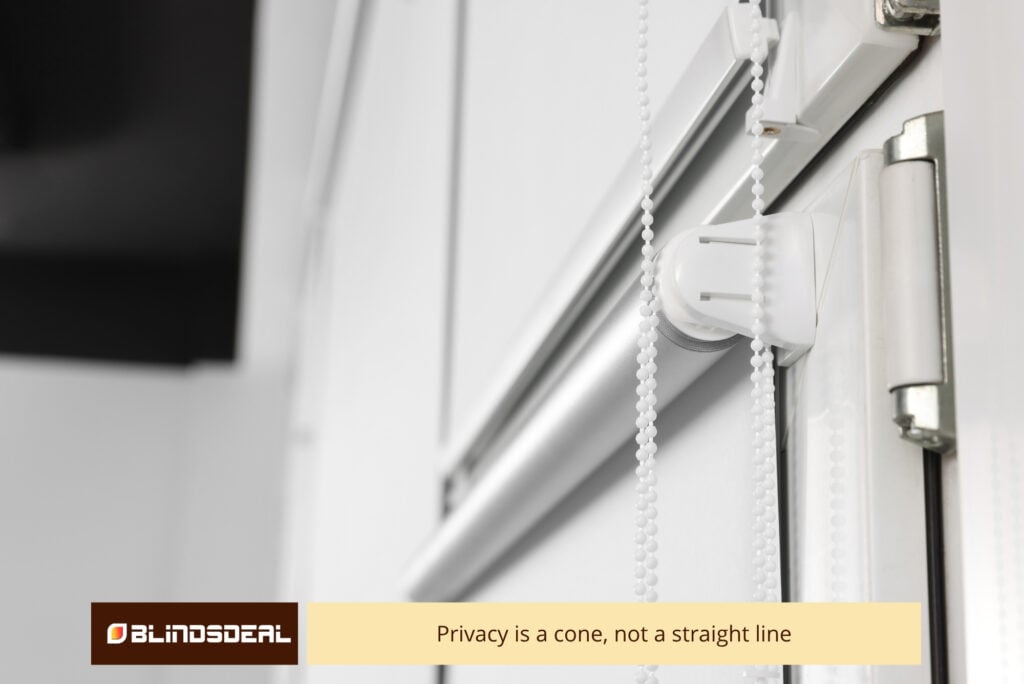
Both styles leak, and they leak in different places.
With a roller, it’s the sides. An inside mount sits within the window reveal and the fabric is cut narrower than the opening to let the tube turn, so you get a strip of light down each edge. Mounting outside the reveal, over the architrave, covers considerably more.
Roll direction matters too and hardly anyone mentions it. A back roll drops the fabric down the rear of the tube, closer to the glass, which tightens that side gap. A front roll clears deep sills and window handles but sits further off the wall. You choose both the mount type and the roll direction when you order, so it’s worth thinking about before you check out rather than after.
The federal government’s guidance on windows makes the same point for thermal reasons: coverings work best when they reach the floor and wrap to the wall on either side. Privacy follows the same logic.
With verticals, the leaks are the vane seams and the ends of the track. There’s a second consideration as well. When you draw verticals back they stack against one side of the opening and sit over part of the glass, where a roller rolls up out of the way entirely.
| Roller blinds | Vertical blinds | |
| Privacy when fully closed | Total with a blockout fabric | Vane seams remain as thin sightlines |
| Directional control | None, it’s up or down | Rotate to block one angle and keep daylight |
| After dark | Blockout stops silhouettes outright | Fabric dependent, seams still leak |
| Suits | Bedrooms, bathrooms, street-facing rooms | Sliding doors, wide openings, big living areas |
| Where it leaks | Side gaps at the reveal | Vane seams and track ends |
| In a breeze | Fabric stays flat against the window | Free hanging vanes swing and open up |
| Stacked open | Rolls up clear of the glass | Stacks across part of the opening |
If the room is a bedroom, a bathroom, a media room or a lounge facing the footpath, get a blockout roller. Nothing else in this comparison gives you the same certainty for the money, and prices start at $84 with free delivery.
If you’re covering a sliding door or a window wide enough that a single roller starts to feel like a garage door, custom vertical blinds make more sense. Accept that the seams will let a little through at night and pair them with a curtain if the room faces a neighbour.
If you want both, order a dual roller. Sunscreen fabric for the day, blockout for the night, both on one bracket, and you stop choosing between light and privacy.
One last thing. People spend a long time agonising over the style and about ten seconds on the fabric, and it should be the other way around. A sunscreen vertical and a sunscreen roller will both leave you exposed at night. A blockout of either style won’t. Get the fabric right first, then pick the style that suits the opening.
Ready to sort it out? View our roller blinds and get an instant price on your window size.